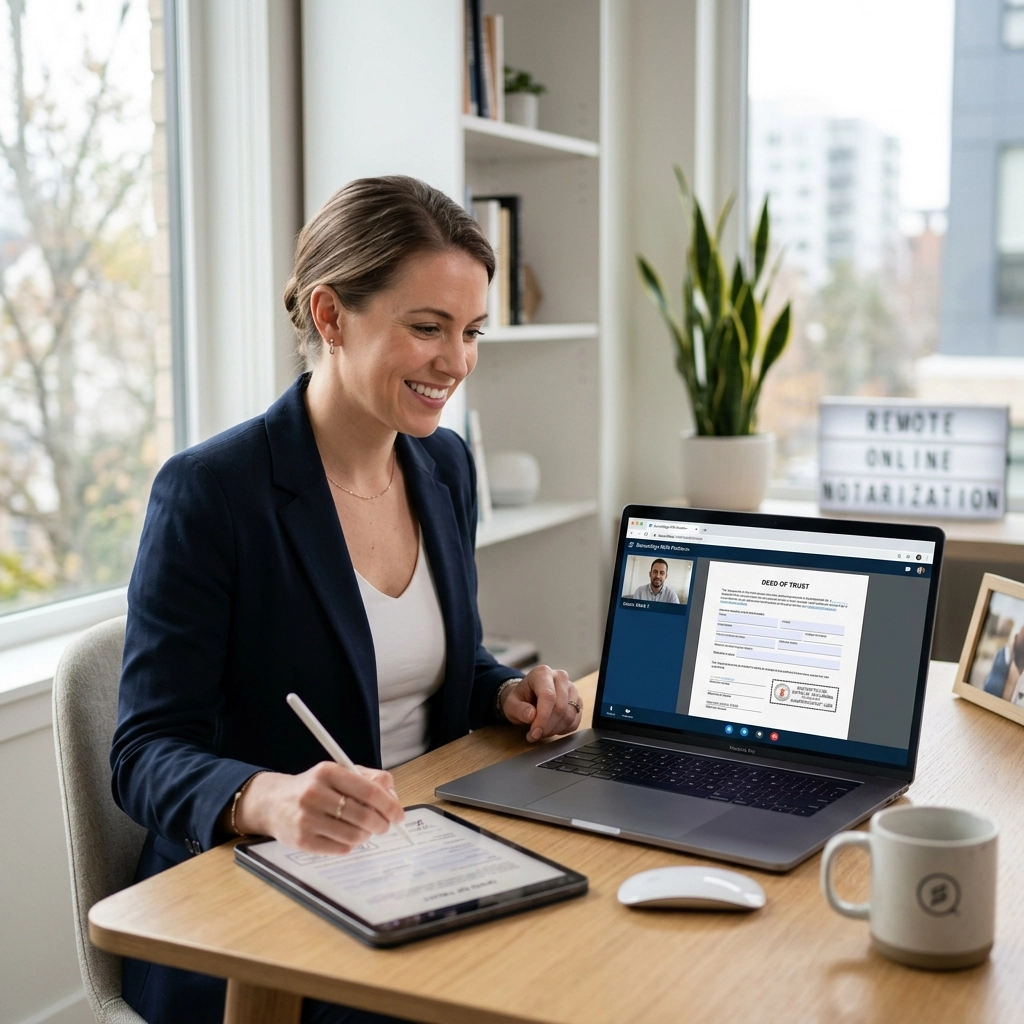
It’s Thursday, April 2nd, 2026. Imagine waking up, grabbing a coffee, and realizing today is closing day. In the old world, let’s call it the "Pre-Digital Era", this would involve a frantic search for a working pen, a stressful commute through morning traffic, and an hour spent in a sterile conference room breathing in the scent of stale espresso and old toner.
But it’s 2026. The question isn't just "when is the closing?" but "does the office even matter anymore?"
For most home buyers, sellers, and busy real estate pros, the answer is a resounding "not really." The physical conference table has been replaced by the secure digital portal, and the heavy leather chairs have been swapped for the comfort of a home office (or even a favorite armchair). Remote Online Notarization (RON) has moved from a "cool new thing" to the industry standard.
If there’s still a bit of hesitation about ditching the traditional office visit, it’s likely just a case of "how does this actually work?" rather than a lack of desire for convenience. Let’s break down why the "Office Closing" is becoming a relic of the past and how to master the art of the remote signature.
The Shift from Mahogany to Megabytes
The tradition of the office closing was built on the need for physical verification. A notary had to see a face, touch an ID, and watch a wet-ink signature hit the paper. It felt secure because it was tangible. However, as we’ve seen over the last few years, "tangible" doesn't always mean "efficient" or even "more secure."
By 2026, the technology behind Remote Online Notarization has become so sophisticated that it often surpasses the security of an in-person meeting. We’re talking about multi-factor authentication, credential analysis that can spot a fake ID better than any human eye, and an encrypted digital trail that’s nearly impossible to tamper with.

When considering the transition, it helps to look at why everyone is talking about remote online notarization. It’s not just about avoiding traffic; it’s about a closing process that fits into a modern life rather than forcing a modern life to stop for a closing process.
What is RON, Really?
If the term still feels a bit tech-heavy, think of Remote Online Notarization as a secure, virtual version of the traditional notary process. It allows a commissioned notary to perform their duties using audio-video technology.
Here is the quick-start reality of a RON session:
- Identity Verification: Instead of just handing over a driver's license, the signer uploads a photo of their ID to a secure platform. The system runs a quick analysis to ensure it's the real deal.
- KBA (Knowledge-Based Authentication): The signer answers a few questions that only they would know (like "Which of these addresses have you lived at?"). It’s a quick layer of security that takes about thirty seconds.
- The Video Call: A live, commissioned notary joins the signer on a secure video feed. They witness the digital signature in real-time.
- The Digital Seal: The notary applies a digital seal and certificate, making the document legally binding and ready for the record books.
It’s fast, it’s clean, and it doesn't require a single drop of ink. If the idea of a digital signature still feels a bit foreign, catching up on loan signing agent 101 can help demystify how these professionals manage the final hurdles of a deal.
Why the Office Closing is Losing its Spark
Let's be honest: the office closing was never really about the office. It was about the result. Now that the result can be achieved from anywhere, the "office" part feels like an unnecessary extra step.
1. The Time Factor
In 2026, time is the most valuable currency. For a real estate agent, an office closing means two hours blocked out for travel and the meeting. For a buyer or seller, it might mean taking a half-day off work. With RON, that time commitment drops to about 15-20 minutes. It turns a "event" into a "task," which is exactly what a closing should be in a high-speed market.
2. Location Independence
What if the seller is in New York and the buyer is in Florida? In the old days, this meant expensive overnight couriers and "mail-away" closings that could delay funding by days. Now, everyone just hops on a link. It appears that the geographical barriers that used to cause headaches are essentially gone.
3. Reduced Paper Friction
Physical files get lost. Pages get missed. Coffee gets spilled. Digital documents don't have those problems. If a signature is missed during a RON session, the software usually points it out before the session can even end. It’s a built-in safety net that prevents the "oh no, we have to go back" phone call the next day. Sometimes, 7 mistakes you’re making with closing paperwork can be entirely avoided simply by switching to a digital workflow.

Is There Still a Place for "In-Person"?
While RON is the future, there’s still a spectrum of services available. Some people prefer the hybrid approach, the Mobile Notary. This is for the person who wants to sign at their kitchen table but still prefers a human being standing next to them.
When deciding between the two, it's worth weighing RON vs. mobile notary to see which is better for your next closing. While RON is the ultimate in convenience, a mobile notary offers that high-touch personal feel that some deals might still require. However, even mobile notaries are leaning more into digital tools to speed up the process. If you find yourself stuck in the old ways, you might want to stop wasting time on in-office signings.
The Role of the Closing Coordinator in a Remote World
You might think that because the process is digital, it’s "automatic." Not quite. Behind every smooth RON session is a closing coordinator or transaction coordinator making sure the gears are greased.
These pros ensure the title company, the lender, and the notary are all looking at the same version of the documents. They manage the invites, troubleshoot any "uncooperative internet connections," and make sure the digital room is ready to go. Without them, even the best technology can feel a bit clunky. If a deal feels like it’s wobbling, it’s often a sign that a coordinator is needed to save the real estate deal from falling apart.
Preparing for Your First RON Session
If you’re ready to ditch the office visit, here is a quick checklist to ensure things go off without a hitch:
- Check Your Tech: You don't need a supercomputer, but a steady internet connection and a working webcam (phone or laptop) are non-negotiable.
- Have Your ID Ready: Make sure it’s not expired. The system is very picky about expiration dates.
- Find a Quiet Spot: Background noise can make the audio-video recording difficult for the notary to certify later.
- Review Early: Most platforms allow you to view the documents before the notary joins. Take that time to read, so the session is strictly for signing.

The Verdict for 2026
The "Office Closing" doesn't matter nearly as much as it used to. While some might miss the celebratory handshake in a lobby, most people prefer the hour of their life they get back by signing remotely. Real estate is about moving forward, and Remote Online Notarization is the vehicle that’s getting us there faster.
At Finest Closing Services, we specialize in making sure these digital transitions are seamless. Whether you need a RON expert, a mobile notary to come to your door, or a transaction coordinator to handle the heavy lifting, we’re here to help.
Ready to schedule your next remote closing or have questions about how to get started? Give us a call at (407) 305-0497 and let’s get your deal across the finish line without the commute.
Common Questions About Remote Online Notarization (Q&A)
Is Remote Online Notarization legal in all states?
By 2026, the vast majority of states have permanent RON legislation. Even in states with specific nuances, the "Full Faith and Credit" clause of the U.S. Constitution generally requires states to recognize out-of-state notarizations, provided they were performed legally in the originating state.
Do I need a special app for a RON closing?
Usually, no. Most platforms operate through a secure web browser. You’ll receive a link via email, and as long as your camera and microphone permissions are turned on, you’re good to go.
What happens if the internet cuts out during the signing?
Don't worry: it happens. If the connection drops, the notary will typically pause the session. Once you're back online, you can rejoin. The software is designed to ensure the integrity of the recording is maintained even if there's a minor technical hiccup.
Is RON more expensive than an office closing?
Actually, when you factor in the cost of gas, childcare, or time taken off work, RON is often the most cost-effective option. Many title companies and notary services offer RON at a very competitive rate because it saves them the overhead of maintaining physical meeting spaces.
How do I know my data is safe?
Platforms used for RON must meet strict state-mandated security standards. This includes end-to-end encryption and secure storage of the video recording (which is required by law to be kept for several years). It’s often much safer than leaving paper copies of your ID lying around a busy office.