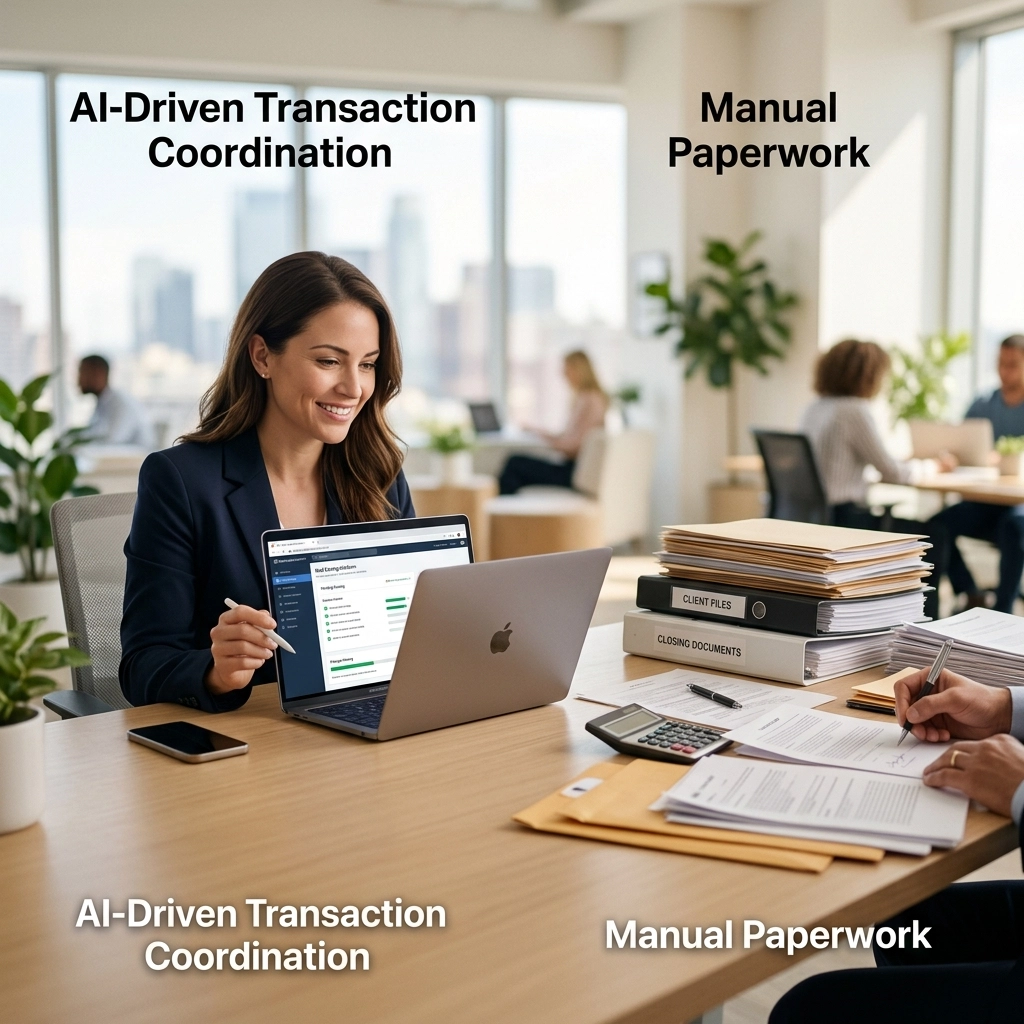
Closing day should be a celebration. It marks the end of a long journey and the start of a new chapter for buyers and sellers alike. But for the professionals behind the scenes, the agents, brokers, and coordinators, the road to that final signature often feels like a marathon through a paper storm.
In the high-stakes world of real estate, the back-office process has traditionally been a manual, labor-intensive grind. We’re talking about endless email chains, spreadsheets that never seem to stay updated, and the constant fear of a missed deadline. However, the landscape is shifting. AI-driven transaction coordination is stepping into the spotlight, promising to replace the "old way" with something faster and more reliable.
But which one is actually better for your closing? Let’s dive into the differences between the traditional manual approach and the modern, AI-powered future.
The Reality of Manual Paperwork: A Heavy Burden
Manual paperwork has been the standard for decades. It relies on human expertise, physical folders, and digital spreadsheets that require constant manual entry. While this method feels familiar, it doesn't always scale well when business starts booming.
When you're handling a couple of closings a month, manual tracking is manageable. But once that volume increases to ten or twenty deals, the cracks start to show. Static checklists are great until a contract amendment comes in and you forget to update the calendar. Or maybe an inspection contingency deadline is missed because it was buried on page 34 of a PDF that wasn't properly indexed.

Manual systems often create a "reactive" environment. You're constantly playing catch-up, responding to urgent emails from lenders, and double-checking dates that should have been automated. It’s a significant drain on your most valuable resource: time. Statistics suggest that transaction coordinators often spend upwards of 15 hours every week just on manual document verification. That’s time that could be spent closing more deals or building client relationships.
If you’ve ever felt like your manual search for the right notary or document was eating your day, you might want to stop wasting time on manual notary searches and look at how AI can streamline those specific bottlenecks.
The AI Revolution: Speed and Precision
AI-driven transaction coordination isn't just a fancy digital filing cabinet. It’s an intelligent system that actively reads, understands, and organizes your closing data.
Instant Data Extraction
One of the most impressive feats of AI in the real estate space is its ability to scan a 40-page purchase agreement and extract the "meat" of the deal in under 60 seconds. It identifies the parties involved, the purchase price, the earnest money deposit requirements, and every single contingency deadline.
Dynamic Timelines
Unlike a static spreadsheet, AI-driven platforms build dynamic transaction timelines. If a closing date gets pushed back, the AI can automatically recalculate all subsequent deadlines and sync them with your CRM or Google Calendar. This reduces the "human error" factor significantly. We’ve all seen deals get messy because someone miscounted the "three days after effective date" rule. AI doesn't miscount.
Handling Handwritten Documents
It’s 2026, yet we still deal with handwritten signatures and notes on scanned documents. Traditional software struggles with this, but modern Generative AI models can read handwritten contracts with surprising accuracy, ensuring that nothing gets lost in translation.
Comparing the Numbers: Manual vs. AI
When we look at the data, the choice becomes pretty clear. On average, AI-driven coordination saves between 1 and 3 hours per deal. For a high-volume team, that’s a game-changer.
| Feature | Manual Paperwork | AI-Driven Coordination |
|---|---|---|
| Document Processing | 30–60 minutes per document | Under 5 minutes |
| Deadline Tracking | Manual entry in calendars | Auto-populated & synced |
| Scalability | Limited to human capacity (approx. 20-30 deals) | Virtually unlimited |
| Error Risk | High (Human oversight) | Low (Data-driven verification) |
| Lease Abstraction | 30-60 minutes | 5-10 minutes |
Maybe it looks like a small difference on a single deal, but multiply that by 100 transactions, and you’re looking at reclaiming 40 to 80 hours of work every month. That’s an entire full-time employee's worth of time saved just by switching systems.

How Finest Closing Services Bridges the Gap
At Finest Closing Services, we understand that technology is only half the battle. You still need the professional touch and the "boots on the ground" to get the job done. That’s where our offerings come in. We combine the efficiency of modern tech with the reliability of a professional service team.
Remote Online Notarization (RON)
One of the biggest perks of moving toward a digital-first approach is the ability to use Remote Online Notarization. Instead of mailing documents back and forth or driving across town, everything happens in a secure, digital environment. It’s faster, it’s safer, and it fits perfectly into an AI-driven workflow.
Mobile Notary Services
Even in an AI-driven world, sometimes you need a physical presence. Our mobile notary services ensure that no matter where your client is, a professional is there to guide them through the final signatures. This hybrid approach, using AI for the coordination and professional humans for the execution, is the "Finest" way to close.
You can learn more about how we handle these moving parts on our services page.
Addressing the Common Pitfalls
While AI is powerful, it’s not magic. If you’re not careful, you can run into some common issues. We’ve actually put together a guide on 7 mistakes you’re making with AI-powered notary searches to help you avoid the typical growing pains of adopting new tech.
Often, the issue isn't the AI itself, but how it's integrated into your existing workflow. You want a system that talks to your email, your CRM, and your closing team without creating more work for you.
Scaling Without the Growing Pains
The biggest advantage of AI-driven coordination is scalability. In a manual system, if you want to double your business, you usually have to double your staff. Hiring, training, and managing new people is expensive and time-consuming.
AI allows you to scale your output without a proportional increase in costs. Your AI "assistant" doesn't get tired, doesn't need a lunch break, and doesn't forget to follow up on a missing document at 4:55 PM on a Friday. It lets a small, nimble team handle the volume of a much larger corporation.
Conclusion: Which Is Better?
If you value accuracy, speed, and the ability to grow your business without burning out, AI-driven transaction coordination is the clear winner. Manual paperwork has served the industry well for a long time, but it simply can't keep up with the demands of the modern real estate market.
At Finest Closing Services, we're here to help you navigate this transition. Whether you need expert coordination, a mobile notary, or a secure RON closing, we have the tools to make your process seamless.
Ready to see how we can streamline your next closing? Give us a call at (407) 305-0497 or visit our contact page to get started.
Common Questions About AI in Real Estate Closings
1. Is AI-driven transaction coordination safe for sensitive data?
Yes, modern AI platforms used in real estate are built with high-level encryption and compliance standards (like SOC2). They are designed to handle sensitive PII (Personally Identifiable Information) securely, often more so than physical paper files sitting on a desk.
2. Can AI really understand complex contract clauses?
AI models like those used by Finest Closing Services are trained specifically on real estate documents. They are excellent at identifying standard clauses, but they also highlight "unusual" language for a human to review. It’s a partnership between tech and expertise.
3. Will AI replace my transaction coordinator?
Not exactly. It replaces the "busy work" your coordinator does. Instead of typing data into a spreadsheet, your coordinator can focus on solving complex problems, talking to clients, and ensuring the deal stays on track. It makes them a "super-coordinator."
4. How long does it take to switch from manual to AI-driven systems?
Most teams can begin seeing the benefits within a few days. The key is starting with one specific workflow: like document extraction or deadline tracking: and expanding from there.
5. Does Finest Closing Services work with both manual and AI-friendly teams?
Absolutely. We adapt to your workflow. Whether you’re fully digital or still love your paper folders, we provide the professional closing services you need to get the job done right.

If you're curious about how we can help your specific business, check out our about page to learn more about our mission and our team. Don't let paperwork hold you back: let's make your next closing the finest one yet. Call us today at (407) 305-0497.