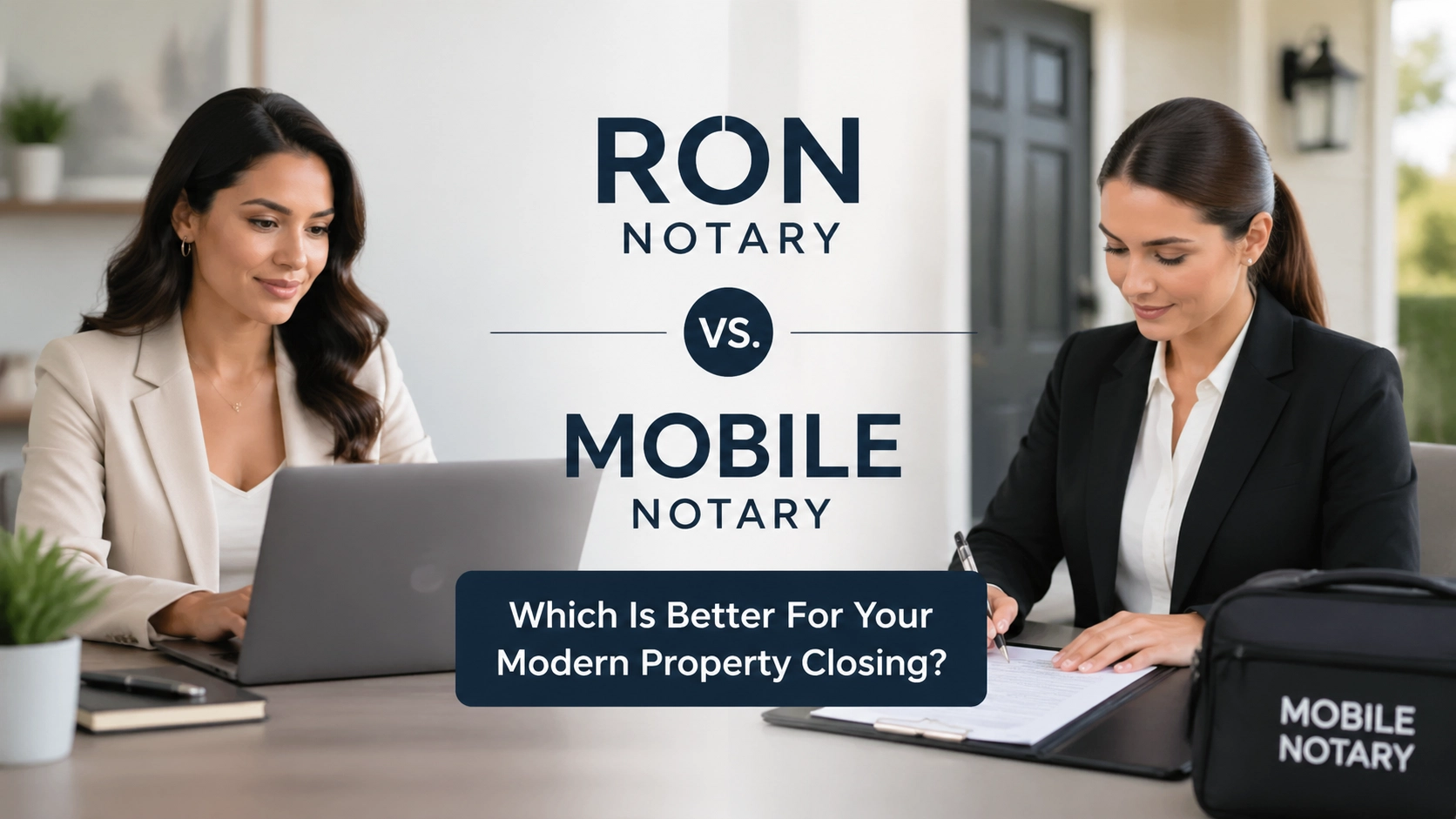
Closing on a property used to mean one thing: clearing your schedule, fighting traffic, and sitting in a sterile conference room for two hours while you signed your name a hundred times. It was a chore. Fast forward to 2026, and the landscape of real estate has shifted. Whether you're a buyer, a seller, or a real estate agent, you’ve likely heard the terms "RON" and "Mobile Notary" tossed around.
The big question isn't just what they are, but which one actually makes your life easier. When the pressure is on and the closing date is looming, choosing the wrong method can lead to delays, frustration, and a lot of unnecessary stress. Let's break down the differences, the perks, and the potential pitfalls of each to see which fits your modern property closing.
The Digital Frontier: What is Remote Online Notarization (RON)?
Remote Online Notarization, or RON, is essentially the "Zoom" version of the notary world. Instead of meeting someone in person, you connect with a notary over a secure video link. You sign your documents digitally, and the notary attaches an electronic seal.
It sounds simple because it is. In the last few years, RON has become the go-to for tech-savvy investors and busy professionals. It’s built on a foundation of high-tech security. You aren't just showing a driver's license to a person across a table; you’re undergoing multi-factor authentication and credential analysis that’s much harder to spoof than a physical ID.
If the idea of staying in your pajamas while closing on a half-million-dollar home appeals to you, RON is probably calling your name. It’s fast, it’s efficient, and it removes the geographic barriers that used to stall out-of-state deals.

The Road Warrior: What is a Mobile Notary?
A mobile notary is the classic version of the service, just with wheels. Instead of you going to them, they come to you. Whether it’s your office, a local coffee shop, or your kitchen table, a mobile notary brings the paperwork and the stamp to your doorstep.
While RON is all about the digital experience, mobile notaries are about physical presence. Some people just feel more comfortable having a human being standing next to them, pointing out where to sign and where to initial. It’s a tactile, "old-school" approach that still holds a lot of value in a world that’s increasingly digital.
Mobile notaries are often the unsung heroes of the real estate world. They handle the "wet signatures", that's industry speak for actual ink on paper, which some lenders and courthouses still demand.
Speed and Convenience: The Ultimate Showdown
When it comes to pure speed, RON wins by a landslide. You don't have to wait for someone to drive through traffic or find a parking spot. You log on, verify your ID, and you’re done in fifteen minutes. This is a game-changer for quick closings where every hour counts.
However, convenience is subjective. If you aren't great with technology or your internet connection is spotty, a RON session can quickly turn into a headache. There’s nothing more frustrating than a video feed cutting out right when you’re about to sign a deed. In those cases, having a mobile notary show up at your house might actually be the "easier" option.
The Cost Factor: Budgeting for Your Closing
Generally speaking, RON tends to be more budget-friendly. You’re typically paying for the notary’s time and the platform fee. Since there’s no travel involved, you aren't paying for someone’s gas or the time they spent sitting in a traffic jam.
Mobile notaries usually charge a travel fee on top of their notarization rates. If you’re in a remote area or need a signing in the middle of the night, those fees can climb. But for many, the extra $50 or $100 is a small price to pay for the peace of mind that comes with an in-person expert handling a massive stack of loan documents.

When Technology Hits a Wall: Legal Limitations
Here’s where things get a bit tricky. Not every document is eligible for RON. While most states have embraced online notarization, some local jurisdictions or specific lenders are still catching up.
If your lender requires "wet ink" signatures, RON isn't even an option. Similarly, if you’re dealing with international property or certain types of trusts, you might find that the courthouse won’t accept a digital seal. This is why it’s so important to work with a transaction coordinator who knows the local rules. They can spot these "red flags" early on, so you don't schedule an online session only to find out at the last minute that it won't work.
The Human Element: Why Mobile Notaries Still Matter
There’s a certain level of complex hand-holding that a mobile notary provides which a screen just can’t replicate. Real estate closings are emotional. For many, it’s the biggest financial decision of their lives.
A mobile notary can sense when a signer is hesitant or confused. They can wait patiently while someone reads through a 50-page mortgage document for the third time. They can also handle physical witnesses, which are often required for deeds in states like Florida. While RON platforms have ways to include witnesses virtually, it can sometimes feel a bit clunky compared to having everyone in the same room.
The "Secret Sauce": Closing Coordination
Whether you choose RON or a mobile notary, the real magic happens behind the scenes. If your closing workflow is a mess, it won't matter how the documents are signed.
At Finest Closing Services, we act as the bridge between the technology and the people. We help determine if RON is a viable option for your specific deal, or if a mobile notary is the safer bet. Our job is to make sure the right person shows up at the right time, virtually or physically, with the right papers.
We take the guesswork out of the process. Instead of the real estate agent spending their afternoon playing phone tag with notaries, we handle the logistics. This allows the pros to focus on finding the next deal while we ensure the current one crosses the finish line smoothly.

Making the Choice: A Quick Checklist
Still not sure which way to go? Ask yourself these four questions:
- Does the lender allow digital signatures? This is the first hurdle. If they say no, you’re going mobile.
- Is everyone tech-savvy? If the signers struggle with email, a RON session might be a recipe for disaster.
- Are there witnesses involved? While possible online, in-person is often smoother for documents requiring multiple witnesses.
- How fast do you need it done? If you need it done now, RON is your best friend.
Why AI and Modern Tech are Changing the Game
We’re seeing a shift where AI-driven platforms are making RON even more secure and user-friendly. From automated ID verification to real-time document checking, the "modern" closing is becoming more automated every day.
For those who want to stay ahead of the curve, embracing these tools is essential. You can learn more about why everyone is talking about AI-driven closings and how they are streamlining the entire industry. It’s not just about the signing; it’s about the entire ecosystem of the transaction.
Common Questions About RON and Mobile Notaries (Q&A)
Q: Is RON as legal as a traditional notary?
A: Yes, in most states. Remote Online Notarization carries the same legal weight as a physical stamp, provided the notary is following state-specific statutes and using a certified platform.
Q: Can I use a mobile notary if I’m out of the country?
A: Usually, no. If you’re abroad, you’d likely need to visit a U.S. Embassy or use a RON service (if allowed by your state and lender). A mobile notary can’t exactly fly to Paris for a quick signature.
Q: What happens if the RON platform crashes during my closing?
A: It’s rare, but it happens. Usually, the session is restarted. If the issues persist, your closing coordinator will likely pivot to a mobile notary to ensure you don't miss your deadline.
Q: Are RON services more expensive than "notary near me" searches?
A: It depends. While RON saves on travel fees, the technology platform fee can be comparable to a local notary's basic rate. However, when you factor in your own time and gas, RON usually wins on value. You can check out more things to know before booking a notary.
Q: Can a closing coordinator help with both?
A: Absolutely. At Finest Closing Services, we specialize in managing both RON and mobile notary appointments, ensuring that whatever method you choose, it’s executed perfectly.
Final Thoughts: The Best of Both Worlds
In the end, there isn't a "wrong" choice, just a "better" choice for your specific situation. RON offers the speed and futuristic feel that fits a digital world, while mobile notaries provide the reliability and personal touch that real estate has relied on for decades.
If you’re feeling overwhelmed by the logistics of your next closing, you don't have to figure it out alone. Let us handle the details so you can enjoy the moment the keys change hands.
Ready to streamline your next closing? Give us a call at (407) 305-0497 or visit our contact page to see how we can help. Whether it’s online or in-person, we’ll make sure your closing is the finest experience possible.