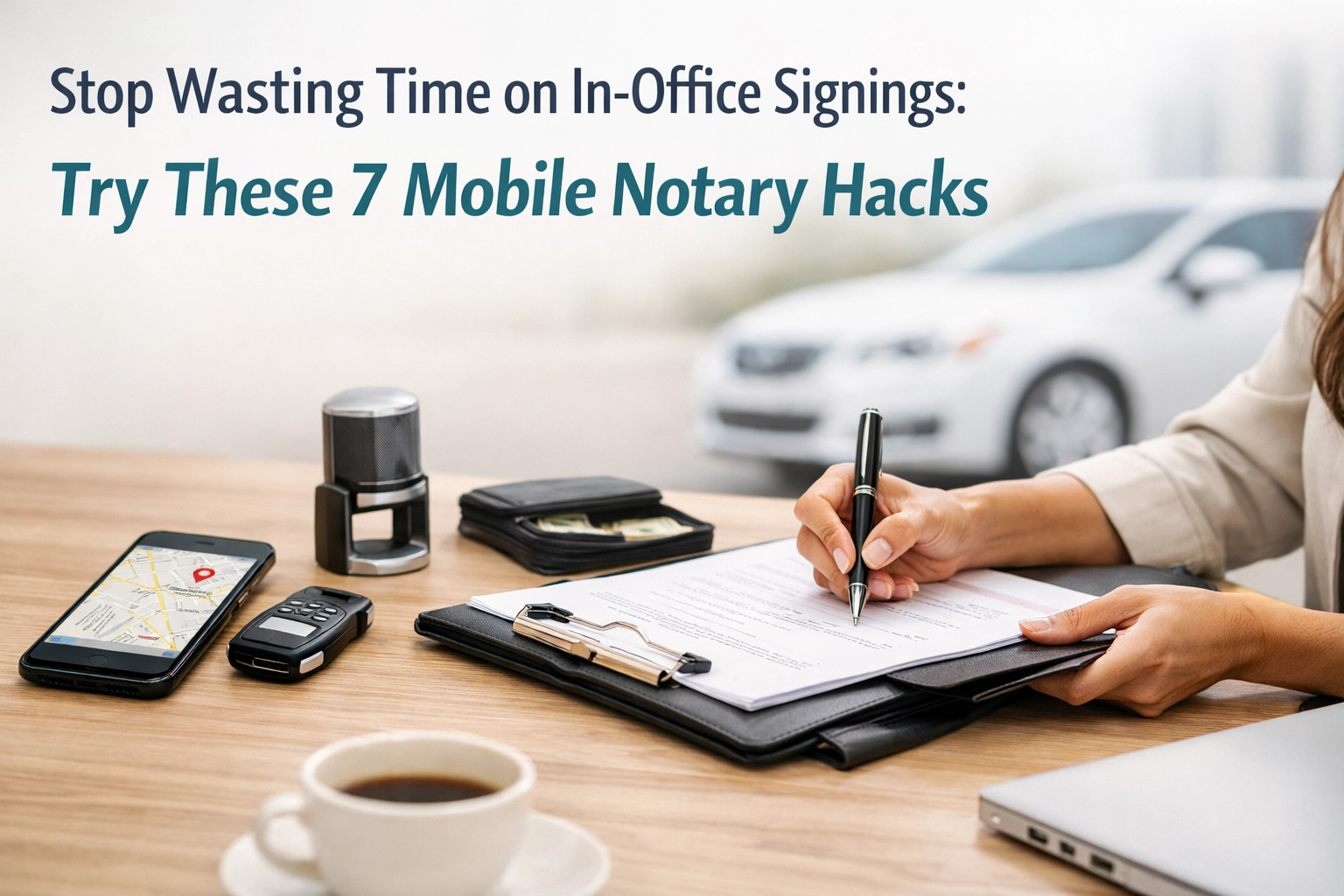
Traffic in 2026 isn't getting any better, and neither is the frustration of sitting in a sterile office waiting for a printer to warm up. For real estate professionals and home buyers alike, the traditional "in-office" closing can feel like a relic of the past. It looks like the industry is shifting toward a more flexible model, where the notary comes to the client, not the other way around.
Finest Closing Services has seen how much time can be reclaimed when the signing process is streamlined. If the goal is to close deals faster while keeping everyone’s blood pressure low, these seven mobile notary hacks are going to be a game-changer.
1. The 24-Hour "No-Surprises" Rule
It doesn't seem to matter how many times a closing is scheduled; a small detail can always slip through the cracks at the last minute. The best way to avoid a "no-go" situation is a strict 24-hour confirmation protocol.
Maybe send a quick text or email the day before to verify a few key details:
- Are all signers physically present?
- Is there a valid, unexpired government-issued ID for everyone?
- Do we have the exact number of witnesses required by the state?
Getting ahead of these questions prevents those awkward moments where the notary arrives and the seller realizes their license expired three days ago. For more on ensuring everything is in place, checking out our ultimate guide to hiring a loan signing agent might be a smart move.
2. Master the "Digital Scouting" Technique
Notaries often lose precious time just trying to find the front door or a parking spot. It looks like a little digital scouting can save ten minutes of circling the block. Using a GPS app that shows a street view of the destination helps identify parking restrictions or complex gate codes before arrival.
If the signing is happening at a public place: like a coffee shop or a library: maybe suggest a specific corner that is quiet and well-lit. A mobile notary's efficiency is only as good as their ability to actually get to the table.

3. Build a "Mobile Command Center"
A mobile notary shouldn't just be a person with a stamp; they should be a walking, talking office. If the paperwork has a typo or an extra page is needed, driving back to the office is a total productivity killer.
Keeping a "command center" in the vehicle is a professional lifesaver. This includes:
- A portable, high-speed scanner (or a high-quality scanning app on a smartphone).
- A backup mobile printer for those "oops" moments.
- A "signing kit" with various pens (blue ink is usually the standard, but it doesn't hurt to have options).
- Extra notary certificates (Acknowledgments and Jurats).
Having these tools on hand makes a notary look like a hero when a document needs a quick fix. You can learn more about how these small details impact the overall closing experience here.
4. The "Blue Ink Only" Habit
It’s a classic real estate headache: the documents were signed, but the lender rejected them because the ink looked like a photocopy. To avoid this, it’s best to make blue ink the absolute standard for every mobile signing.
Blue ink makes it immediately clear that the document is an original. It's a small detail, but it prevents the "did they actually sign this?" phone call from the title company three days later. It looks like such a simple fix, but it saves hours of re-signing and courier fees.
5. Centralize Group Signings
When a deal involves multiple signers: perhaps siblings selling an inherited property or a corporate board: trying to coordinate three different locations is a logistical nightmare.
Instead of playing "tag" across the city, maybe suggest a central hub. This could be a shared workspace, a quiet restaurant, or even a local community center. Centralizing the group ensures that the notary only has to set up once, and all IDs can be verified in one go. It keeps the momentum high and the "paperwork fatigue" low.

6. Embrace the "Hybrid" Reality
While fully Remote Online Notarization (RON) is becoming more popular, many transactions still require a physical presence. However, that doesn't mean the whole process has to be analog.
One of the best hacks is the "Hybrid" approach:
- Review the documents digitally 48 hours in advance.
- Address questions via a quick video call.
- Use the mobile notary visit purely for the "wet ink" signatures.
This reduces the time spent sitting at a kitchen table explaining what a "Note" is, allowing the notary to be in and out in fifteen minutes. If you're curious about the legality of digital options in your area, take a look at our latest breakdown on RON.
7. Outsource the Coordination
The ultimate hack for real estate agents and title companies is simply not doing the coordination themselves. Managing schedules between a buyer, a seller, and a notary is a full-time job.
By using a dedicated service like Finest Closing Services, the logistics are handled by professionals who do this all day, every day. It doesn't seem like much until you realize you've gained back five hours a week that were previously spent on "Where are you?" phone calls.

Why Efficiency Matters in 2026
The real estate market moves fast. A delay of a single day can sometimes mean the difference between a closed deal and a frustrated client. Mobile notary services aren't just about convenience; they are about maintaining the "flow" of a transaction.
When things are handled professionally and quickly, it reflects well on everyone involved. Buyers feel supported, sellers feel respected, and agents look like superstars. It’s about taking the friction out of the most stressful part of the home-buying journey.
If you’re ready to stop wasting time on old-school office signings and want to see how a streamlined mobile process can work for you, we’re here to help. Whether you need a single document notarized or a full closing coordinated, reach out to us at (407) 305-0497 or visit our contact page to get started.
Questions & Answers
Q: What is the main benefit of a mobile notary over an in-office signing?
A: The primary benefit is convenience and time-saving. Mobile notaries travel to the client's location, whether it's a home, office, or coffee shop, eliminating the need for the client to commute and wait in a traditional office setting.
Q: Are mobile notary services legal for all real estate documents?
A: Generally, yes. As long as the notary is commissioned in their state and follows state-specific laws regarding identification and witnessing, their work is just as valid as an in-office notary. However, it's always good to verify specific lender requirements.
Q: How much does a mobile notary typically cost?
A: Costs vary based on location, the number of documents, and travel distance. Many mobile notaries charge a standard notarization fee plus a travel or "convenience" fee. For a detailed quote, you can check our offerings.
Q: What should I have ready before the mobile notary arrives?
A: You should have all documents printed (if not provided by the notary), a valid government-issued photo ID for all signers, and any required witnesses. It’s also helpful to have a clear, well-lit space to sign.
Q: Can a mobile notary help if I don't have a printer?
A: Many professional mobile notary services, including those coordinated by Finest Closing Services, can print the documents for you and bring them to the appointment. Just be sure to mention this when booking.
Q: What happens if there is a mistake on the document during a mobile signing?
A: If it's a minor typo, some states allow for neat corrections with initials, but for major errors, a new document may need to be printed. This is why having a notary with a "Mobile Command Center" (portable printer) is a huge advantage.
Ready to experience a smoother closing? Give us a call at (407) 305-0497. It looks like your next closing could be your easiest one yet. You can also browse our blog for more tips on navigating the 2026 real estate landscape.